Graph Chess, or graph-based chess, is a new way of looking at chess positions. A position is divided into three fundamental graphs:
- Pawn Graph (PG)
- Mobility Graph (MG)
- Coordination Graph (CG)
The Pawn Graph (PG) represents the pawn chains in a chess position. It tells us how good the pawn structure is, or how good the map of the position looks.
Too many isolated pawns, doubled pawns, or other weaknesses can indicate a poor PG.
The Mobility Graph (MG) is related to each piece and its movement. It is not just about the path a piece can take from its starting position. It is also about its current location and the number of roles it plays in the position.
A piece that can play more useful roles has greater flexibility, and its contribution to the MG is better.
The Coordination Graph (CG) is the support network of pieces. It tells us how the pieces support each other. When I talk about the support system in chess, I am only talking about piece-to-piece coordination.
A pawn supporting a piece, or a piece guarding a pawn, is not part of the CG as defined here.
You can read and learn more about Graph Chess in this article: What Is Graph Chess?
Graph Chess- A Positive Structure
When we look at a chess position, we think of three graph structures. We can also think of them as positive structures.
The PG represents the pawn chains. It provides a map of the position. Similarly, the MG represents the current activity and flexibility of the pieces. We wouldn’t want to place a piece on a passive square if we could place it somewhere more useful.
Graph moves are transformations of graphs. The idea is to maintain or improve the positive structure of the position. Similarly, when a chess piece supports other pieces, it contributes to the positive structure of the CG.
In short, Graph Chess looks at chess moves as transformations that should maintain or improve the structure of the graphs.
Do graphs have negative structures?
Yes!
Graph Negatives
In this article, I am going to introduce the negative structures of a position, known as Graph Negatives.
Traditionally, chess positions have weaknesses, and those weaknesses are exploited to beat the opponent. If you are familiar with positional chess, you will know that weaknesses can be related to:
- King safety
- Material
- Pawn structure
- Mobility and activity
- Initiative
- Development
- Space advantage
Graph Chess also recognizes these elements and the weaknesses that arise from them. However, the graph model provides a filtering system. It helps us focus on specific weaknesses instead of treating every positional feature as equally important.
If we keep observing every possible weakness, we might get into time trouble or become confused by too many variables during calculation. There are already many candidate moves to consider during a game.
We need to calculate the possible outcomes of our candidates to select the best move. But selecting the right candidates in the first place can be difficult in traditional chess.
For higher-rated players, this might be less of a problem because they have learned thousands of chess patterns through experience.
The problem is more serious for improving players who are still trying to understand positions and decide what to do.
Here is the basic idea behind Graph Negatives:
A Graph Negative is a pawn or piece that no longer contributes properly to its respective graph.
A doubled or isolated pawn can be a negative in the PG because it loses some of the flexibility and structural benefits of a connected pawn chain.
A trapped or passive piece can be a negative in the MG because it has lost useful activity or flexibility.
A hanging piece is a negative in the CG because it has fallen outside the effective support network of the pieces.
In Graph Chess, these are our targets.
First, they are relatively easy to spot once you become familiar with the graph structures.
Second, they can help us decide what to attack instead of getting lost in the maze of positional features.
Of course, we still need to calculate whether an attack works. Identifying a negative is only the starting point.
Examples of Graph Negative
I am going to give three examples of Graph Negatives, one for each type of graph in a chess position.
Negatives of a pawn graph
When we look at a pawn structure, we find that pawns can lose flexibility in several ways. Pawns that cannot advance effectively, such as backward pawns, or pawns that have become structural weaknesses, such as doubled or isolated pawns, can be negatives in the PG.
If you spot them in your game and have an opportunity to attack them, you should consider doing so.
Here is an example of a negative in the Pawn Graph.
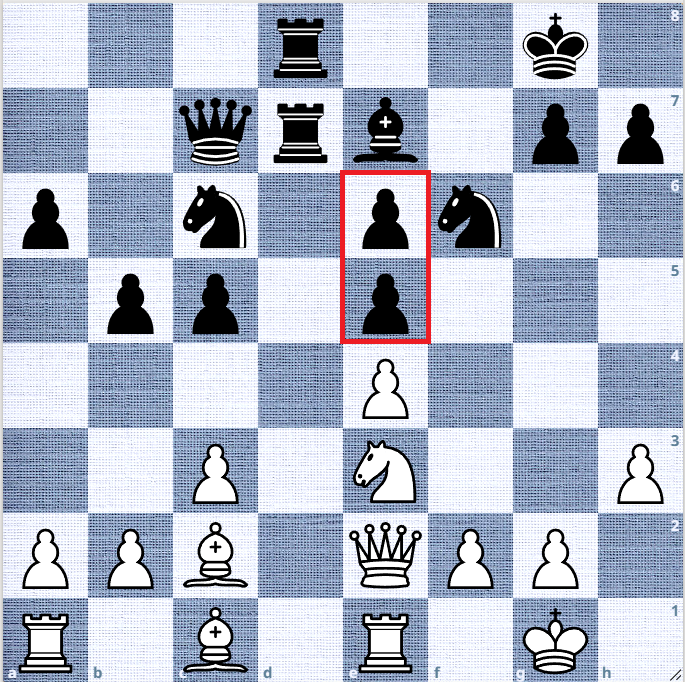
Figure: Bobby Fischer vs. Samuel Baron, 1956.
In this position, Fischer has just captured the bishop. Following the capture and recapture, Black is left with doubled pawns.
This is a negative in the Pawn Graph (PG). The doubled pawns have lost some of the structural benefits that a connected pawn chain can provide.
The idea is simple: identify the negative and look for an opportunity to exploit it.
Next, let’s look at an example of a Mobility Graph Negative.
Negatives of Mobility Graph (MG)
The Mobility Graph has two common kinds of negatives:
- A piece with no useful role to play.
- A trapped or passive piece.
No Roles for a Piece
A piece in a position is not very flexible if it has no useful role to play.
Such a piece may not attack anything, contribute meaningfully to the defence, or help control space in the position. That is why it can be considered a negative in the Mobility Graph (MG).
Trapped or a Passive Piece
Piece can be trapped if they are immovable, and do not have safe squares to go. If they have safe squares, they can still be doing nothing and remain passive. This is second kind of negative in the mobility graph (MG).
A piece can be trapped when it has no safe squares to move to. Even when it has safe squares available, it can still be passive if it isn’t doing anything useful.
This is the second kind of negative in the Mobility Graph.
The following example is taken from a game between Magnus Carlsen and Hans Krogh Harested, 2003.
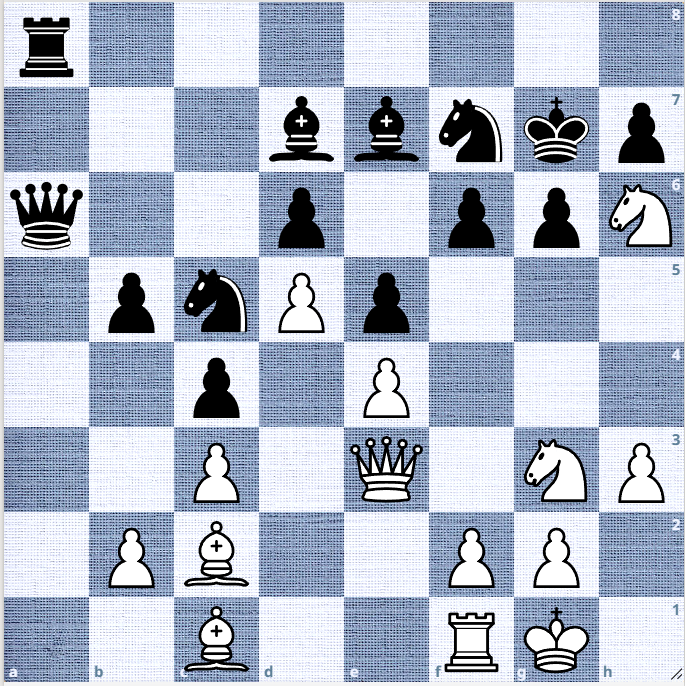
Figure: Magnus Carlsen vs. Hans Krogh Harested, 2003.
In the position above, the dark-squared bishop on c7 is passive. It isn’t doing much in the position.
You might argue that it is protecting the pawns, but those pawns are already safe. So, what useful role is the bishop actually playing?
This is a typical example of a Mobility Graph Negative.
The main idea of Graph Chess is to recognize these negatives and, if possible, attack them. Sometimes, we may also need to improve our own pieces to make better use of their flexibility.
In this game, White won.
Negatives of Coordination Graph (CG)
The Coordination Graph is the support network of the pieces. It can be difficult to predict the outcome of a position simply by looking at coordination, but we cannot underestimate its importance.
Unsupported pieces can be vulnerable to capture. When our pieces support one another, they are often better placed to withstand threats and maintain control of important squares.
For example, consider the following position from a game between Anatoly Karpov and Klaus Wockenfuss, 1977.
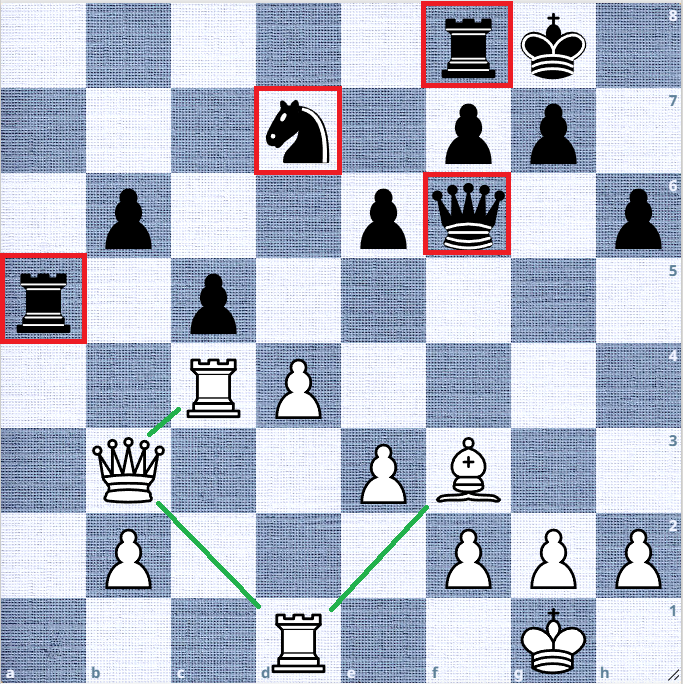
Figure: Anatoly Karpov vs. Klaus Wockenfuss, 1977
In the position above, the White pieces are well coordinated. They support one another and work together.
The Black pieces, on the other hand, have lost much of their coordination and support. They are scattered across the board rather than working together effectively.
This is a negative in the Coordination Graph (CG).
In the game, Anatoly Karpov eventually won.
Key Takeaway
There are only three important points to remember.
- Graph Chess looks at positions through positive structures.
The three graphs represent the pawn structure, the activity and flexibility of the pieces, and the coordination between pieces. We want to maintain or improve these structures.
- Look for Graph Negatives.
When pawns or pieces lose their useful contribution to their respective graphs, they can become targets for the opponent. You should look for the same opportunities in your own games.
- The Mobility Graph is the most important of the three graphs.
The Pawn Graph (PG) is like a map or terrain for the position. The Mobility Graph (MG) represents the activity and flexibility of the pieces. The Coordination Graph (CG) is the support system for the pieces under the MG.
Together, these three graphs provide a different way to look at a chess position and identify the weaknesses that matter.
Explore Graph Chess
Learn more about Graph Chess, a graph-based approach to understanding chess positions.