It is well known that the underlying structure of chess can be described using graph theory. There are many GitHub repositories and academic papers that provide evidence for viewing the graph as a fundamental language for describing chess.
A graph is a mathematical structure, and I am introducing the concept because the graph-based method depends on this underlying structure. However, learning and playing chess using Graph Chess does not require you to learn the mathematics of graph theory.
A graph consists of nodes and edges, forming a flexible network-like structure. Nodes and edges may have different properties, but what makes them part of a graph is the relationships between them. These relationships allow us to represent how different elements of a system are connected to one another.
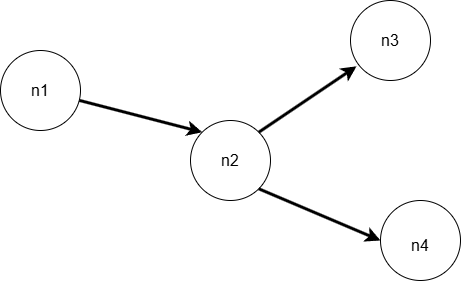
The chess pieces can be represented as a graph network, forming a new abstraction that can help us simplify the learning and playing of this wonderful game.
Before we discuss this new abstraction, let us first understand the traditional chess philosophy.
A game of chess has three distinct phases. However, there is no clear boundary between one phase and another:
- Opening
- Middlegame
- Endgame
The ultimate goal of a chess game is to checkmate the opponent and win the game. There are many rules governing the movement of chess pieces, along with principles and unwritten rules associated with each of these three phases.
Traditional chess provides players with three major tools for playing the game:
- Tactics
- Positional play
- Strategy
Let us explore each of them briefly.
Tactical Chess
Tactics are short sequence of move with predictable outcome such as material gain. After you executed one or more tactics, you will gain enemy pieces or pawns.
However, its not guranteed. The players are supposed to calculate the entire sequence and visualize the outcome before playing it.
I will not be listing any tactics in this articles, because out topics is about graph chess.
Positional Chess
The second aspect of chess is the positional play, when tactics in the chess position does not exist.
Chess players analyse the position to know whether a tactics exists or not. If not then they move according to positional play. The goal of the positional play is to improve the position such that it will create tactical opportunities.
What are the positional aspects in a chess positon?
- King Safety
- Material
- Space
- Pawn Structure
- Mobility
- Initiative
- Dynamic vs Static Advantages
We shall again discuss this briefly.
King Safety
When a chess player starts analysing a position, King safety is usually one of the first things to consider for both sides. You can check whether the King has castled, whether pieces are pointing towards the King, and whether any lines have been opened towards it. These factors help you evaluate King safety.
Material Advantage
Which side has more material? This is a fundamental question when evaluating a position. Material is usually a relatively permanent difference between the two sides. However, having a material advantage does not necessarily mean that a player is winning. There are other aspects of the position that need to be considered.
Space Advantage
How much space do you control, particularly on the opponent’s side of the board? This is the basic idea behind space advantage. The opponent may also control some squares in your territory.
Space is important because it gives your pieces more room to move and can provide useful squares for placing pieces or launching tactical operations.
Pawn Structure
Pawn structure acts like a map of the position for both sides. Chess players pay close attention to pawn structure and generally try to avoid weaknesses such as isolated pawns, weak pawns, doubled pawns, and backward pawns.
Pawn structure can influence the strengths and weaknesses of a position for a long time, sometimes even throughout the entire game.
Mobility
Piece mobility is probably one of the most important aspects of a chess position. Trapped, undeveloped, or passive pieces have limited mobility and are therefore less active.
Active pieces, on the other hand, have access to more useful squares and can participate more effectively in the position.
Initiative
Initiative is the ability to create demands that require the opponent to respond. It is often confused with a threat.
A threat is usually directed towards a particular piece, pawn, square, or tactical objective. An initiative is broader: it is the ability to make moves that keep putting the opponent under pressure and force them to respond to your actions.
Dynamic vs. Static Advantage
A dynamic advantage is an advantage that may exist for a relatively short period or have a temporary effect on the position before disappearing.
For example, developing a piece quickly can provide a dynamic advantage. An initiative is also dynamic because it may depend on maintaining continuous pressure. Quick development can, in turn, create an initiative.
A static advantage has a more long-term effect on the position. Material, pawn structure, and space are examples of factors that can create static advantages.
The same factors can also become static weaknesses. For example, a weak pawn structure, a material deficit, or a lack of space can remain as a long-term problem in a position.
The Graph Chess
The graph chess is an abstract sturcture in the chess position. It organize the chess position into three distinct graphs.
- Pawn Graph (PG)
- Mobility Graph (MG)
- Coordination Graph (CG)
Graph Chess tries to go one step further than the traditional chess. It looks at the relationships between these positional features and tries to use those relationships to understand the position and improve the decision-making process.
The main idea of Graph Chess is to see the positions as positive graphs and make decisions using them.
The Pawn Graph
We already know graph is a network of connected nodes. In chess, the nodes are the chess pieces, including pawns.
If we think of the 64 squares of a chessboard as a network of squares, then by excluding the empty squares, we get a network of pieces.
In this network, some pieces naturally connect through different relationships.
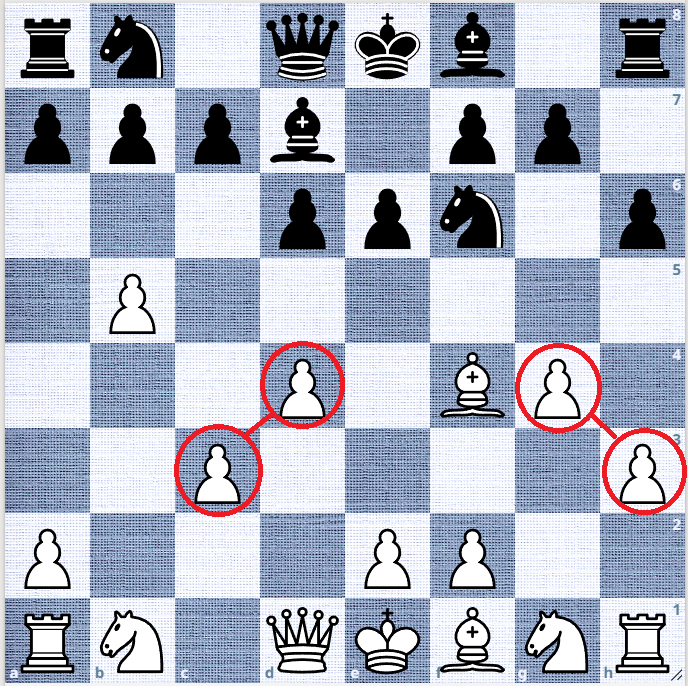
In the case of pawns, a pawn chain is one of the important structures. A Pawn Graph (PG) represents the positive relationships between pawns.
In figure 2, we show an pawn graph and the pawns c3-d4-e5 is a pawn graph. The chain a2-b3 is also pawn graph for White side.
We will leave the discussion of isolated pawns, doubled pawns and other pawn structures for later.
This abstraction provides a way to look at the health of the pawn structure from a different perspective.
Another important aspect is flexibility. The PG can be evaluated using a scoring system that takes these structural characteristics into account.
The details of the scoring system and how it is used in position analysis are developed in the book.
The Mobility Graph (MG)
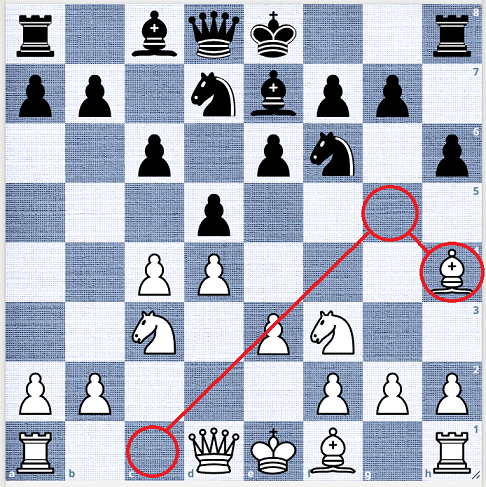
When a piece moves from its original position to its current position, the path created by its movement forms a Mobility Graph (MG).
Like a pawn chain, it can be viewed as a chain created through the path of the piece.
The MG is concerned with the current position of the piece. We are not evaluating the piece based on where it was, but on what it can do from where it is now.
Every piece except pawns has a Mobility Graph.
There are different ways to evaluate the mobility of a piece. One important question is:
How many roles does the piece play from its current position?
The more roles a piece can play, the more flexible it becomes. This flexibility can then be represented through a score.
The following diagram shows the MG of the White Bishop.
Future positions are explored through an analysis and calculation system using Graph methods.
Graph Chess does not replace traditional chess. You can switch between the traditional and graph-based ways of looking at a position whenever you need to. The two systems are complementary rather than competitive.
CG — Coordination Graph
The Coordination Graph (CG) is created by multiple pieces from the same side. The pieces are connected through their supporting relationships, forming a chain of different pieces.
A piece in the CG has a supporting role, but it also has its own Mobility Graph (MG). This distinction is important.
In the following position, the knight on f3 supports the bishop on g5. At the same time, the knight itself is supported by the queen, creating a chain of supporting pieces.
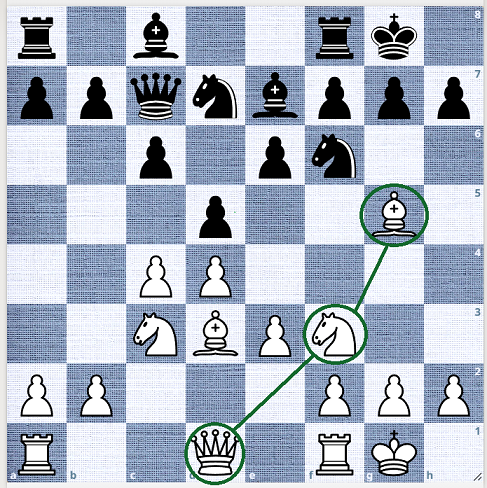
The CG is the dedicated support system for the pieces. Its strength is related to the flexibility of the pieces in supporting one another.
An overloaded piece has limited flexibility in this supporting network.
The CG can also be affected by tactical disruptions and sacrifices. When a connection is broken, the coordination may have to be rebuilt or reorganized.
The detailed scoring and analysis of the CG are developed in the book – Hidden Graphs of Chess.
Explore Hidden Graphs of Chess
Discover Graph Chess, a graph-based approach to understanding chess positions, strategy, and flexibility.
♟ GitHub: Explore Hidden Graphs of Chess
✉ Substack: Follow the journey and read new articles