
Many club players lose games not because of strategy but because of calculation mistakes.
Calculation mistakes happen when a player t analyzes variations incorrectly or incompletely. In this article, you will learn a simple thinking process used by strong players. Before that you must learn what calculation means.
Club players usually make a few predictable types of errors.
Here are common types of calculation mistakes in chess:
- Ignoring the opponent’s best move
- Stop calculation too early
- Calculating too many moves
- Missing forcing moves
- Visualization errors
- Not evaluating the final position
- Hope chess
- Simple blunders
Strong players do not guess moves, or blunders – they calculate variations systematically.
What is Calculation in Chess?
Calculation is the process of analyzing forcing moves and predicting positions before making a move. The main purpose of looking for forcing moves and predicting final positions is:
- to avoid blunders
- find tactical opportunities
- evaluate the position accurately
Example 1:
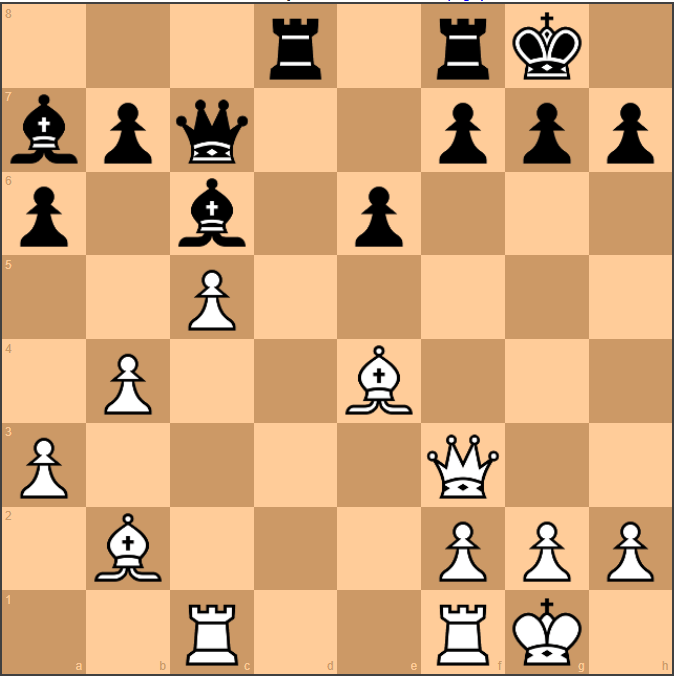
In this game, white evaluated the position and found that all black pieces are on queen side. The black king is undefended, especially the pawns in front of it.
How can white take advantage of this position ?
Following moves were played.
1. Bxh7+ Kxh7
2. Qh5+  Kg8
3. Bxg7  Kxg7
4. Qg5+  Kh8
5. Qf6+  Kg8
6. Rc4  Black resigned
Most moves were forcing moves that involve check, capture, etc. The black king is forced to move, and it cannot bring other pieces for defense.
Also, white saw that the black pieces cannot protect the exposed black king after bishop sacrifices.
White calculated all of these, before moving Bxh7+.
Now we discuss how strong players, calculate in chess.
A Simple Calculation Rule
Strong players follow simple rule. They always look at forcing moves first, and then the positional or non-forcing moves. The forcing moves includes:
- checks
- captures
- threats
These moves limit opponent choice of responses, and easy to calculate.
We will see how to calculate in a systematic way.
A Simple 4-Step Calculation Process
The position decides whether you have to calculate or not. In closed position, you may not need to calculate and their will be less opportunities for tactics. However, if the position is open, it requires us to calculate multiple variations and choose that works for us.
Here is a systematic way to calculate using 4-step calculation process.
Step 1 – Identify the candidate moves
In a chess position, not everything is important. If you calculate everything that will result in confusion, and time trouble later in the game. Identify 2-3 candidate moves. The goal of the position determine what move is worth considering.
For example,
Ask what is my goal ?
- Am I attacking the opponent king ?
- Am I trying to win material through tactics ?
- Do I need to improve position?
- Am I defending against a threat ?
The process does not end here, it has just started. We have to consider many other things before deciding the candidate moves.
Step 2 – Start with forcing moves
As we said before, forcing moves limit the responses from opponent. Always look for forcing moves and calculate the sequence first. Look for checks, captures, and threats (CCT). The response should also be guessed in the same manner. It is easy to compute these because opponent choice is limited.
Example 2:
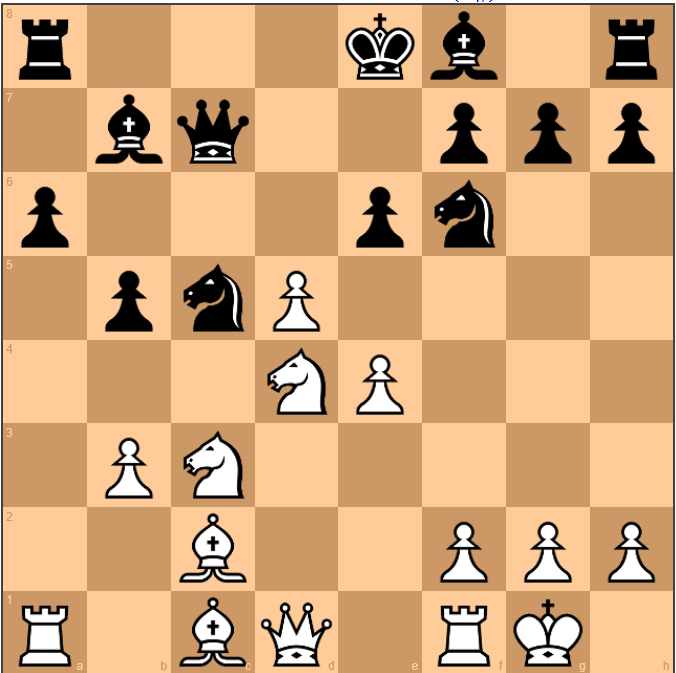
In the above game, black has more pawns on the queen side and but King is in the center and unsafe. The white center is shaky, and it is about to open. Black must play tactical and use forcing moves.
Following moves were played from this position:
1. ...b4
2.Na4 Nxe4
3.Bxe4 Nxe4
4.dxe6 Bd6
5.exf7+ Qxf7
Black went on to win the game.
You can see how both player, played forcing moves, where goal for each player is different. Back wants to destroy the center, and take advantage of two bishops pointing at the white king.
White on the other hand want to keep black King in the center, but knights, or any other pieces are incapable in doing so. That brings us to the next question. What will be final position after calculation ? is it favorable to us or the opponent?
Step 3 – Visualize the final position
After you have calculated a line, visualize the final position in your mind. See who is better , who have more material, and king safety.
The visualization practice is important to develop a mind’s eye where you can clearly hold positions.
Step 4 – Compare all candidate moves
After chosing all the candidates and performing step 1 -3 on them. You can compare the candidates and play the best move. If a candidate is looking better, but another one ask to defend a mating attack. You should defend against mating attack. Choose move that is highest priority in the position.
How to Train Calculation
There are few practical methods to train your calculation skills. Here is a list of activities to improve calculation skills.
- Solve tactical puzzles daily.
- Analyze your own game.
- Practice Blindfold Chess to improve visualization.
- Study tactical books.
Each training activities must be active, not passive effort. Chess improvement is never possible with passive activites such as watching chess videos or bullet chess. At the beginning, play slower game that give you enough time for systematic calculations.
Conclusion
Calculation is one of the most important skills in chess. By improving your calculation, and following a structured thinking process, you can avoid blunders and find stronger moves consistenly.
But, to improve calculation, one must practice chess activities properly and consistently.
Pingback: 7 Chess Opening Mistakes Beginners Make
Pingback: 5 Essential Checkmate Patterns in Chess